This Is For The Birds

This Is For The Birds

Friday, July 8, 2016

Tracking a Snowy Owl


We Followed a Snowy Owl from Maryland to Ontario
               by Adam Cole
May 25, 2016
 
…Brinker and fellow bird biologist Scott Weidensaul knew if they could follow the movements of these wide-ranging owls as the birds returned to the frozen north, the scientists could learn a lot about their hunting patterns, breeding behavior and migration routes. So the two men launched Project Snowstorn.

They trapped visiting owls and fitted them with solar-powered GPS transmitters. http://www.npr.org/2016/05/24/479223874/we-followed-a-snowy-owl-from-maryland-to-ontario


Friday, March 11, 2016

Tuesday, February 16, 2016

Rescued Snowy Owl

Watch a Snowy Owl Recoup from Surgery at an NYC Wildlife Rehab Center
By Purbita Saha
February 5, 2016

Meet Hedwig, an aptly named Snowy Owl who flew all the way from the Arctic tundra to the Big Apple to enjoy a milder winter (and also probably a #pizzarat or two). That is, until she was shot near an NYC airport—likely the result of a legal loophole that allows airports to use lethal means to clear owls and other birds off their tarmacs.

But Hedwig is a lucky one: She was found and rescued two weekends ago, right before a record blizzard hit the city. A Queens resident found her struggling to fly a mile away from LaGuardia Airport,

A Gunshot Wound Couldn’t Break this Snowy Owl’s Spirit
by Hilary Hanson
February 11, 2016

A lot of birds are afraid when they wind up at the Wild Bird Fund—a wildlife rehabilitation center in New York City—but not Hedwig.

A man brought in the young female snowy owl with what rehabbers believe was a gunshot wound in her shoulder in January, as first reported by the National Audubon Society.

But while many birds become timid and frightened in the unfamiliar environment of the rehab center, Hedwig was defiant.

“She did not retreat,” Rita McMahon, Wild Bird Fund director, told The Huffington Post. “I think she felt … she didn’t see anything that was contender. She was lord and mistress.”

Iceberg Threatens Colony of Penguins

I’m having a problem with the real title of this article; not because it is ten miles long, but because of the words have been killed. I would use the words have died instead.

[150,000 Penguins Killed]
by May Bulman
February 13. 2016

An estimated 150,000 penguins of Cape Denison in Commonwealth Bay have been killed since the iceberg measuring 1,120 square miles - larger than Luxemberg - forced them to trek 70 miles for food.

The penguins used to live near a large body of open water, but the arrival of the iceberg in East Antarctica and fast ice expansion has dramatically increased the distance they must travel to feed.

The colony of 160,000 has shrunk to just 10,000 since 2011, according to research carried out by the Climate Change Research Centre at Australia’s University of New South Wales.


Saturday, February 13, 2016

Wisdom, the Albatross, Gives Birth at Sixty-five

Wisdom Hatches a Healthy Chick at 65+ Years Old
Papahānaumokuākea Marine National Monument
February 8, 2016

The oldest known bird in the wild, a Laysan albatross named Wisdom – at least 65 years old – is a mother again at Midway Atoll National Wildlife Refuge, part of Papahānaumokuākea Marine National Monument. The chick was observed still coming out of its shell on February 1, 2016 and days later was named Kūkini, which is a Hawaiian word for messenger. Wisdom’s mate had been on the nest since January 20 when he took over incubation duties while Wisdom headed out to sea. Wisdom returned just as the Super Bowl ended yesterday with her belly full. Shortly after Wisdom arrived, Wisdom’s mate was on the march towards the shoreline and immediately took flight in search of food.

Since I found Wisdom:

64-year-old Laysan Albatross Returns, Spotted with Mate
by Maui Now
November 25, 2015

Oldest Known Wild Bird Hatches Chick at 62
by Christine Dell’Amore
February 22, 2013

Sunday, January 31, 2016

U.S. Court Upholds Airports’ Right to Kill Birds

U.S. Court Upholds Airports’ Right to Kill Birds

U.S. Court Upholds Airports’ Right to Legally Kill Snowy Owls and Other Birds
by Xander Zellner
January 29, 2016

The Port Authority of New York and New Jersey now has the legal right to kill almost any bird on its property—as long as they declare it an emergency.

[…]

The only birds that are exempt are Bald Eagles, Golden Eagles, and other endangered or threatened species.

So does this mean Snowy Owls and other favorite species have to learn to steer clear of these properties? Maybe not. Susan Elbin, director of conservation and science at New York City Audubon, says that despite the court's ruling, she's confident the Port Authority will try to avoid killing birds. "I know for a fact that they'll only use lethal control as a last resort. They spend days and days meeting about this subject and catching these birds," she says. In fact, the Port Authority often consults with NYC Audubon about methods for handling wildlife. "It’s unfortunate when wildlife and humans come into this conflict situation where they’re trying to share space—and that’s often what happens with airports—but I know that the Port Authority is doing their best to trap and relocate them."

I hope Susan’s confidence doesn’t become compromised. Airplane safety should be the paramount concern, but we all know it’s cheaper and easier to shoot birds than to pay for what it takes to capture and relocate them.

Sunday, January 24, 2016

Northern Hawk Owl Killed to Stop People from Coming to Take Pictures of It

After Attracting Birders, Rare Hawk Owl Killed Near Okanogan
by Rich Landers
January 16, 2016

Other birders who had brought the bird to his attention had mentioned to him that the property owner did not want anyone taking photos of anything on his property.

[…]

The Schrevens were among the steady stream of birders that visited the area. They saw the bird alive about 12:30 p.m. on Jan. 9. A Man came out of a home along the road and appeared to be writing down their license number as they drove away, Sandy Schreven said.

[…]

A blue pickup was in the road as they drove past and the man appeared to be writing down their license plate number, she said.

While they were having lunch by the river a half mile away, Herman Schreven said he heard a gunshot, but he didn’t think much of it.

When the couple returned to the site about 2 p.m., they found the bird hanging dead from a tree,
by Becca Cudmore
January 22, 2016

But as the visitors gathered throughout the week—some even checking in from Oregon—a nearby resident grew increasingly annoyed, telling them that scopes and binoculars were “okay,” but that they couldn't take photos of his property. On January 9, birders noticed that the neighbor had posted a sign: “No photos allowed.” Later that day, the owl was photographed hanging dead by one foot from a tree branch. Presumably, it had been shot. The case is currently under investigation by the Colville Native American Tribe, which owns the land.

The answer to the question, “are birders to blame? is no, birders are not to blame. The person who killed the owl is to blame.

The birders were not on the person’s property, it’s probably been too cool and cloudy for naked sun bathing or skinny dipping; so was the perpetrator already some kind of a pervert with some disgusting secret to hide, was this person one of America’s most wanted, did the perpetrator not want others to see an ugly spouse, was it a fear of losing land, was it resentment and hatred for a certain race of people? I’d really like to know.

Notwithstanding, personal moral values forbid me from stating how I really, really feel about the person who did this:

Photo by Christy Nielsen

Saturday, December 13, 2014

September 27: The Ups and Downs of Live Cam Viewing

At approximately 7:51AM marsh time, an ultralight swooped into view, touched down near the start of a strip of close-cut grass, rolled onward to the door of the pen area, and did an about-face. (According to the chatter scrolling up in the chat room box to the right of the reduced live cam view, the ultralight was being piloted by Richard Van Heuvelen.)
http://www.operationmigration.org/operation-migration-team-members.asp

The pen door was opened by one of the two costume-clad crew members located inside the pen. On cue, one by one, six young, backpackless, female Whooping Cranes began nonchalantly sauntering out of the pen to greet the ultralight. Within seconds, Richard revved up the ultralight engine and proceeded to roll, accelerating faster and faster back up the strip of close-cut grass. Five of the cranes had immediately started to accompany the ultralight, and one had hesitated a noticeable moment before following suit. Despite (or perhaps because of) that fleeting moment of angst, the sight of six pair of long legs running and six pair of big white flapping wings in pursuit of the speeding ultralight was exhilarating to my soul. In the next instant, my spirit experienced an uplifting thrill upon seeing that Richard and all six of the cranes were in the air. The takeoff time was 7:53.

The crane that had hesitated: she lagged a bit behind the rest, but soon caught up insomuch as—to my relief—I was eventually able to count six cranes flying behind the ultralight.

I watched Richard lead the cranes, at a relatively low altitude, in what seemed to be a couple of wide circles around the pen area. At one point during the circling, the Operation Migration logo came to mind. The why-of-course-it-would realization of what had just happened to me brought the flex of a smile to my cheeks. At another point during the circling, the view of the ultralight being followed by the birds appeared so surreal to me as to seem totally unreal: like an oversized image of Santa Claus and his reindeer-pulled sleigh being superimposed and crudely manipulated across a NOAA weather radar screen or Miss Gulch riding her bike through the tornado in the Wizard of Oz. Oh, the things that can run through a person’s mind when watching a man in a propeller-powered glider flying through the air with six Whooping Cranes following as if he and the contraption were one in the same and their parent.

My indulgence in the fantastic came to an abrupt halt when I could only make out five birds flying with the ultralight. Again to my relief, however, after a couple of successive counts and a more intense focus on the scene, I was able to discern that a sixth crane kept getting largely concealed by the right side of the ultralight wing.

Subsequently, the live cam operator started having trouble keeping up with Richard and the cranes. The live cam operator lost them and found them a couple of times within a brief period before completely losing track of them for an extended period. For several minutes, the sound of the ultralight engine could be heard; however, the live cam operator’s repeated three-hundred-sixty-degree sweeps failed to spot the aircraft and birds. Eventually, the ultralight engine could not even be heard, and one chatterer quipped that Richard had gone on migration.

After several more minutes—and yet again to my relief—the sound of the engine could be heard again. Then the actual sight of the ultralight came into view, appearing ever so tiny in the distance.  As the ultralight drew closer and the live cam zoomed in, one could once again count the birds in flight. One, two, three, four, five; one, two, three, four, five: every recount turning out the same.

Richard—and to my count—only five of the six cranes were coming in for a landing, and smoothly touching down at approximately 8:13.

As Richard—having exited the ultralight and donned his adult Whooping Crane puppet head—began rewarding the five cranes with what I believe to be grapes, a few of the chatters expressed concern over the missing crane. After several entries of such concern, one chatterer bade us not to worry, proclaiming that the missing crane was hiding “in the blind”. Rather unsure of what that meant, I continued to watch with bated breath.  I watched and counted over and over as Richard—appearing to exhibit no other exigency—continued to toss treats to the five cranes gathered around him and the ultralight.

Those seven subjects—and only those seven subjects—were in the live cam picture until the camera operator focused in on Richard pulling a treat out of his costume pouch with his forearm and hand gloved in the puppet head. Then,  a couple of seconds later, at approximately 8:21, the camera operator pulled the camera’s focus back to the wider view, and, just like that, the count of five cranes increased to a count of six cranes. Not believing my own eyes, I recounted; and to my absolute and total delight, there really were six cranes in the picture.

Shortly thereafter, Richard re-entered the ultralight and began to slowly taxi further down the strip, toward the pen. All six cranes followed the ultralight to an area in front of the pen door. Richard once again disembarked from the aircraft, one of the two costumed crew members swung open the pen door from within, and the three disguised humans began coaxing the cranes back into the pen with treats. The first three to re-enter the pen did so rather quickly and willingly, although they did so one at a time, and while giving each other plenty of space. Richard used a treat in the bill of his puppet head to lure in the fourth crane, and it seemed that he only had to firmly directionally gesture with the puppet head to get the fifth crane to re-enter. The last crane didn’t give Richard much trouble, but she did seem to emit an air of some attitude other than a willingness to cooperate. She wore what appeared to be a red legband, which would make her #3-14.

At  approximately 8:28, with one crew member having left the pen on foot, with all seven cranes (even the still sidelined Peanut) visible in the pen, and with one crew member still in the pen, Richard took off and flew out of sight.

Monday, October 28, 2013

BIRD NOTES 20131028/1842: NORTHERN CARDINALS


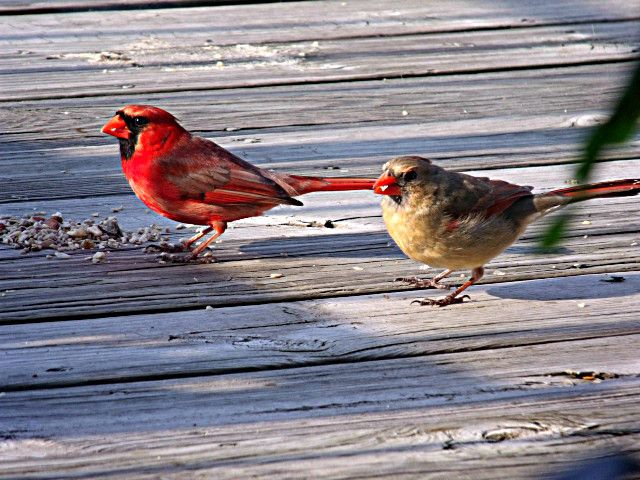
I’m looking at five male Northern Cardinals in my feeder tree. Just two weeks ago this could never have happened. They had been aggressive toward one another since the onset of spring: chasing one another from the feeders, from the tree, males chasing males, and females only slightly less tolerant of one another. With the imminent approach of winter, they’re starting to get along with one another. They are actually quietly, peacefully taking turns on the feeders.

Sunday, October 6, 2013

BIRDS IN THE NEWS: 10/06/2013

Colonizing Songbirds Lost Sense of Syntax
Sep. 26, 2013 — As one species of European songbird island-hopped to colonize mid-Atlantic archipelagoes over the course of a half million years, their songs lost their sense of syntax.
http://www.sciencedaily.com/releases/2013/09/130926123453.htm

Cheats of the Bird World: Cuckoo Finches Fool Host Parents
Sep. 24, 2013 — Cuckoo finches that lay more than one egg in their victims' nests have a better chance of bamboozling host parents into fostering their parasitic young, a study has found.
http://www.sciencedaily.com/releases/2013/09/130924113450.htm

'Shy' Male Birds Flock Together -- And Have Fewer Friends
Sep. 18, 2013 — Male birds that exhibit 'shy' social behaviour are much more likely to join flocks of birds with a similar personality than their 'bold' male counterparts, a new study has found. But shy birds also have fewer social partners than bold birds.
http://www.sciencedaily.com/releases/2013/09/130918102000.htm

New Noisy Bird Discovered in Busy City
June 26, 2013 — Despite its loud call, a new bird species has only just been discovered in Cambodia's capital city of Phnom Penh, scientists announced yesterday (June 25).
http://www.livescience.com/37754-new-bird-discovered-cambodia.html

Say Hello to the Junco/Ordinary Extraordinary Junco Video
June 19, 2013 — Watch the trailer, go to “Read More”, then go to “Videos”.
http://juncoproject.org/

Friday, April 12, 2013

Yellow-shafted Northern Flickers

There are two living subspecies (and one extinct subspecies) of the Northern Flicker: the Red-shafted Northern Flicker and the Yellow-shafted Northern Flicker. The Guadalupe Flicker, which had been found solely on the Mexican island of Guadalupe, is determined to have gone extinct by 1910.

Generally speaking, Red-shafted Northern Flickers are found in western North American and Yellow-shafted Northern Flickers are found in eastern North America. It should be noted, however, that where the ranges of each overlap—a relatively narrow swath that runs from southern Alaska to Northern Texas—they interbreed, creating hybrids with shafts varying in color between the bright red and the bright yellow. The males mustaches also vary between the black and the bright red in instances of interbreeding.

I consider myself quite lucky to have a pair of Yellow-shafted Northern Flickers frequently visiting the feeders of my old Kentucky home.


I'm hoping to see their offspring at my feeders in the not too distant future.

Sunday, February 10, 2013

Paradise Found (by Scholes & Laman)

Back in the middle of December of 2012, while standing in a long line at a regional hypermarket chain store, I scanned the magazine rack and found only one option: National Geographic’s December 2012 issue. The featured cover story—The World’s Largest Trees—immediately grabbed my interest. The magazine opened right up to a foldout poster of a giant sequoia. I had to page back for the beginning of the article, and I started reading about this tree named The President. After a few pages, it was finally almost my turn to check out. I was about to place the magazine back in the rack when something even more fascinating caught my eye: pictures of birds, pictures of birds of paradise. I closed the magazine to check for a price, but before I could find one, it flew from my hands and landed in my shopping cart.

Later that night, after reading Paradise Found, I went to National Geographic online to see if I could find further information. I didn’t. I did this morning though. See.

For the First Time, All 39 Species of Birds-of-Paradise Have Been Capture on Film
For centuries the bird-of-paradise has been a byword for exotic animals and faraway locales, but actually documenting this family has been near impossible. Now, thanks to 8 years and 18 expeditions into Australia, Papua New Guinea, and surrounding islands, the birds have finally all been recorded. (Click the link, then click the video starter arrow)
http://www.popphoto.com/news/2013/02/first-time-all-39-species-birds-paradise-have-been-capture-film

Birds-of-Paradise Project
The birds-of-paradise are among the most beautiful creatures on earth—and an extraordinary example of evolutionary adaptation. On this site you can find what few have witnessed in the wild: the displays of color, sound, and motion that make these birds so remarkable. Then you can delve deeper, examining the principles that guided their evolution and the epic adventure it took to bring you all 39 species. (Click the link, click the “Introduction” tab, and then click the video starter arrow)
http://www.birdsofparadiseproject.org/

By the Numbers
What does it take to come home from New Guinea with images of all 39 species of birds-of-paradise? Summing it up in two numbers—18 expeditions and 8 years—tells only part of the story. Numbers like 544 days, 109 blinds, and 39,568 photos give a little more perspective. Take a look at more numbers from the project to sense some of the energy and dedication that were required behind the scenes. (Click the link, then click the video starter arrow)
http://www.birdsofparadiseproject.org/media.php?page=103

Scientist Bios
Edwin Scholes—Evolutionary Biologist
Tim Laman—Wildlife Photojournalist and Field Biologist
http://www.birdsofparadiseproject.org/media.php?page=116

Monday, January 14, 2013

DINING WITH MY BEST FRIENDS

On December 22, 2012, the sun began setting later and later in the evening; and on January 6, 2013, the sun began rising earlier and earlier in the morning: meaning I’ll gradually start seeing my best friends more and more instead of less and less.

I’m referring to my first visitors in the morning and my last visitors in the evening. Cast to a predominance of relative gloom, ever since autumn—when time fell back—I’ve only had the chance to watch them eat dinner on Saturdays, Sundays, and on the three weekday holidays that just passed. One might think that should have been enough, and maybe it was enough: just enough, because it seems that maybe, perhaps, hopefully we’ve made it through the worst of times.


Nonetheless,it pains me to come home from work in the dark and find their particular feeder empty, and I agonize over taking their particular feeder down before going to work in lieu of letting the squirrels eat it all up by noon. Pretty soon, however, I’ll be able to fill that feeder back up or hang that feeder back up before they fly in for that daily last meal.

Their Particular Feeder

It’s not that I don’t enjoy experiencing them.., …watching them… …do breakfast. I most certainly do enjoy it, and always will. As a matter of fact, I’ve been setting my clock for six-thirty AM on weekends in order to be there when they come.

Every morning, as soon as the sky starts to slightly brighten, they noisily start trickling in. This has been so ever since I first started strategically placing small piles of bird food on my second floor back patio deck.** Since those years-ago days, there have been very, very few occasions when breakfast hasn’t been there for them. Granted, they make that little ticking sound*** whether the food is out there or not—and admittedly, I don’t really know what they are saying with those closed-beak**** morning tweets—but I choose to believe that they are expressing joy when food is there and disconsolation when it is not. Consequently, I feel so heart-wrenched listening to them when food is not there that, since my early September move to my current home, I have made absolutely sure that their favorite fare is available to them every single morning.

Looking out the window, toward that feeder and their pre-dawn vocalizations, initially and despite the faint glow of my porch light, I can’t see the sources. I know who they are, though. I recognize—not so much their voices—but their language. Sometimes, shortly after my best friends arrive, I hear the voices of welcomed interlopers, but the darkness doesn’t render them incognito. Mockingbirds don’t always mock. Sometimes they just be themselves, and squawk. Male Carolina Wrens try to fit in by attempting unseasonable replications my best friends’ spring and summer proclamation riffs. They don’t come close, however, because their voices are way too melodious to confuse them with the rock ‘n roll cords of my best friends. Then there’s the male Song Sparrow who can’t resist a higher-decibel chorus. When he first does it, it seems as though everyone stops and looks in his direction for a moment, quickly sizes it up as cool, and resumes the song.

Inevitably, a few minutes later, I’m able to see silhouettes flittering and fluttering about the miniscule glints reflecting off that feeder; and, naturally, after a few more minutes, I become able to see hints of color.

Subsequently, the sun—whether the sky is overcast or not—starts to ascend above the eastern horizon, and I can then clearly see them: albeit still too dim to get good pictures insomuch as my best friends are to the west and the structure of my home is situated between them and the direct morning sunlight. Due to the obstruction, the only good pictures that I can take are taken with my eyes, and then are stored in the cluttered, unkempt, and virtually unsharable memory of my brain.

Thus, I cannot show how much I thoroughly enjoy experiencing my best friends’ morning arrival, cannot depict how much I thoroughly enjoy my brief workday morning minutes of being able to catch glimpses of them eating breakfast, but so far, it pales in comparison with watching them eat dinner. The sight, the sound, the mood… …emits, conveys, and exudes a more profound aura of accord.

Keeping in mind that the context is very late summer, autumn, and early winter in Louisville, Kentucky, dinner starts as soon as the sun completely descends below the western horizon. After all of the other birds have called it a day, my best friends start to arrive one at a time although closely followed by a mate and, in a couple of cases, offspring. They swoop in directly toward the feeder, save for their instinctual altitudinal undulations. It’s often a brave female who comes first, takes a seed to show that all is well, and then quickly defers, moves away from the feeder to accommodate her mate.

Soon, another one flies in. Moments later, in comes another, and another, and another. One evening, in early October, my field of vision allowed me to count eleven of them: among them were two juvenile females and one juvenile male. Eleven of my best friends—in the same place, at the same time, and not fighting—made for quite the sight to behold.

Generally, the males eat first and rather peacefully work out which of them eats first, second, third, and last; and only a particular male’s mate is deigned to eat on the other side of the feeder at the same time. The young ones disregard the feeder altogether, content with foraging through the grass beneath the feeder for spillage. Adults not at the feeder occasionally join the young ones on the ground, but more often than not, they simply perch a limb in the tree and wait their turn.

The atmosphere is reminiscent of humans conducting themselves appropriately in a fine dining establishment. The exception being such that—with well-mannered humans having dinner in a ritzy restaurant—one would expect to hear the low murmur of quiet voices, the occasional clink of a glass, or the faint sounds of forks coming in gentle contact with plates; but such is not the case with my best friends.

When the cardinals eat dinner, they do it silently: not making a sound.

References

*December 29, 2012
http://www.photoshop.com/users/mitchelle_levone_wright/albums/3dad5bef909942c9978b19841c7a0740

** ever since I first started strategically placing small piles of bird food on my second floor back patio deck.

***little ticking sound
Call recorded by Wilbur L. Hershberger in West Virginia in May of 2001
http://www.allaboutbirds.org/guide/Northern_Cardinal/sounds

****closed beak
Regarding frequency range it seems that a closed beak filters frequencies above 6 kHz whereas a wide beak gape emphasizes high frequencies above 5 kHz and over a broader frequency range.
http://www.plosone.org/article/info%3Adoi%2F10.1371%2Fjournal.pone.0011923
Sunday, September 30, 2012

To Denise Russell: ON CAGING BIRDS

“Unfortunately, because of their beauty, these small finches are captured from the wild by trappers in South Florida and smuggled to South America to become pets. This practice not only reduces their numbers, it skews the bird population when the trappers take only the showy adult males. Painted Buntings are currently listed as: Near threatened by the IUCN and are protected by the U.S. Migratory Bird Act.”

http://birds.joy.net/photo/female-painted-bunting?xg_source=activity


As one who is guilty of having once caged birds as pets, my conscience compels me to address the issue of trapping, smuggling, and keeping them as pets.

Back in 1962, at the age of five, I came home to discover a new resident in our home. My grandmother had acquired a white parakeet. It was love at first sight for me. She told me that his name was Pretty Boy and that I could teach him to talk. I didn’t, for one second, believe that it could talk; however, I did spend countless hours watching it hop around in its tiny cage. I often begged my grandmother to let it out of its cage so I could watch it fly. She always denied my requests. Of course, I eventually took it upon myself to just open the cage door and watch. After seeing what it took to get Pretty Boy back in his cage, I decided I would never do that again.

In the mid-eighties, I discovered the pet store world of exotic finches, and became addicted to collecting pairs of so-called Australian finches: Masked Finches, Shaft-tail Grassfinches, Black-throated Finches, and  Chestnut-breasted Mannikins just to name a few.  I studied them, studied about them, and spent thousands of dollars and hours in collecting and maintaining them. I turned a spare bedroom of my home into what I called the birdroom. The birdroom contained about twenty relatively large cages. The wall-to-wall carpet was covered with wall-to-wall clear plastic matting, the walls were painted with washable satin paint, Vita-Lite full spectrum lighting was installed, and in the center of the birdroom sat a huge cage lined three quarters up in clear thick plastic. It contained the biggest “exotic finch” I ever acquired: a Dusky Lory.

 I felt great pride, joy, and satisfaction with my birdroom, felt I was doing a good thing by taking such well care of my birds. I maintained that menagerie for quite some time, but then, after being visited by a bird breeder, eventually settled on the breeding a single species: the Double-barred Bicheno Owl Finch. There was nothing like the sound of over a dozen Owl Finches greeting the opening of the blinds and the sudden morning sunlight with what I certainly interpreted as cheers.

As time passed, I soon realized that could not sell them because of the emotional attachment of having watched them go from egg to full feather. Finally, due to job relocation, I ended up giving them to the breeder who had gotten me started and had taught me so much.

Now, decades later, I somewhat—but not totally—regret my contribution to illegal bird trafficking, and although I didn’t personally bring them here from their native countries, I rather shamefully see my birdroom as just a little more than a well-kept bird prison.

I still have a lot of birds at my home, but they now come and go as they please. I especially love it when parents bring their new offspring to my feeders and when I see one of them splashing around in my bird bath on a hot summer day.

As far as bird trappers and smugglers are concerned, I wish I could make them stop endangering every bird species. At the same time, I wish these same trappers could be employed to good use. I wish we could capture and facilitate the breeding of endangered bird species to the point where they would no longer be even remotely endangered. I wish secure environments could be created to facilitate the proliferation of endangered bird species regardless of source of threat. I know that many species of birds will not breed in captivity; however, if humans can build a ski resort in the middle of the desert, why can’t humans build a Painted Bunting habitat in Florida. The question is really not a question, because I know the answer: money.

If I were King of the World, though, a bird’s life would be more coveted than money: sort of like the age-old reality of money being more coveted than human life.

 
I know why the caged bird sings, ah me,
When his wing is bruised and his bosom sore,
When he beats his bars and would be free;
It is not a carol of joy or glee,
But a prayer that he sends from his heart's deep core,
But a plea, that upward to Heaven he flings –
I know why the caged bird sings.                                   ---Paul Laurence Dunbar


http://www.youtube.com/watch?v=mux5YhT2MRk

Sunday, September 16, 2012

FAVORITE PHOTOS: 120719 (0748-0755)

Following my perceived botched Great Blue Heron encounter, I resolved to see if I could find a preoccupied bird that didn't see my human presence or a trusting bird didn’t see my human presence as threatening.

Almost immediately, I heard a familiar sound, and pursued it. It wasn’t long before I came upon and saw the source… …or sources: Pileated Woodpeckers. There were three of them when I first spied them, but one of them immediately took off, left in a noisy exit.

Subsequently, I began to shoot, click away at the two of them who stayed before me. I instantly recognized one of them as a male, and began focusing on the red mustache. Whenever the opportunity presented itself, I tried to get both of them by focusing on some point between them. After a minute of two, I realized their pattern of traversing up and down the tree. They would walk, climb, scale up the tree several feet while pecking at it, and then descend back down to the ground, only to start back up it again. They did this repeatedly.

One did it gracefully..,


…and the other flopped, dropped, stumbled, and flailed.


It would be a lie to even imply that I knew what was going on as I viewed the eight-minutes-long spectacle. All I was concentrating on was getting closer, getting them when they weren’t driving their heads toward the tree, getting clearer shots, getting both of them together, getting their eyes. In fact, for all I knew at the time, I was shooting two birds looking for or feasting upon something good to eat in that tree.

A father and son.

Here they are:


I thought I had been spotted by the one that left the other two, but, in hindsight, what I think I saw was a mother telling her mate to teach his son how to find food while she goes to eat breakfast in peace for the first time in two months.

Monday, September 10, 2012

FAVORITE PHOTOS: 120719 (prelude)

For me and my immediate family, the highlight of every summer is the extended family’s annual pilgrimage to Bailey’s Point, Kentucky, which is a camping area situated on a bank of Barren River Lake. (See the peninsula extending out from the south and east of the A, while west of the two lake islands.)  

This year, I and my immediate family arrived there on the 18th of July, and I was up and at it on the 19th by 0700 hours. The place is rather large, but there was a particular area I had long been planning to check out first. There was somebody I wanted to see, someone who had kind’a gotten away from me the year before. This guy:


The above image of a Great Blue Heron was my first somewhat of a capture on the first morning of last year’s stay at Lake Barren. I saw it finishing breakfast in the shallow water of a cove, but not before it saw me. By the time I got over the surprise and was able to focus, it was way high and far away. I went to look for it again first thing on each subsequent morning of the stay, but had no luck.

Over a year later, I was back at it. As I came around the stand of trees to view the cove, just like before, I watched it lift off. If you know anything about the Canon XS’s you know that they take a while to focus. Well, despite being ready for the surprise, I was nonetheless surprised; and by the time I had gotten myself and my camera focused, it had happened again. See:


The irony of getting almost identical misses two years in a row left me wondering whether I had been cursed or blessed.

I later saw the answer.

 
See the bird in the upper right corner? That was my sign.


Sunday, August 19, 2012

FAVORITE PHOTOS: 120701


Granted, the Yellow-billed Cuckoo made my day on the first of July, 2012, but there were a few more of my feathered friends who were there as well. There was a Blue Jay who basically demanded that I take his picture. My favorite goose in the whole wide world was there. There was a pain-in-the-neck male Orchard Oriole who kept me looking almost straight up for roughly ten minutes as he sang his little song from the tops of the highest trees. His wife was there, and she, too, was a pain in the neck. I really did have to look straight up to get her, although she did grant me a face-to-face visit along with a rather forward display of her backside. :) There were also a couple curious young Eastern Bluebirds who didn't seem bothered at all by my presence nor by my focus beam, and there was a Gray Catbird who seemed a quite taken aback by the fact that I had even laid eyes on it.

My top five quality photos:


In time line order, here are the twelve runners up: